The National Association of Surety Bond Producers (NASBP) recently published the second of a two-part article series authored by Adrian D’Arcy in its Surety Bond Quarterly’s summer 2026 edition, titled “Ethical Considerations When a Surety Tenders Its Defense to Its Principal.”
Blog
From Clans to Contracts: The Irish Roots of Suretyship by Adrian D’Arcy

Ancient Ireland operated under Brehon Law, a legal system that functioned for over a thousand years — without prisons, police forces, or centralized enforcement. If one wonders how people in this society made sure debts were paid and contracts were honored? They used sureties.
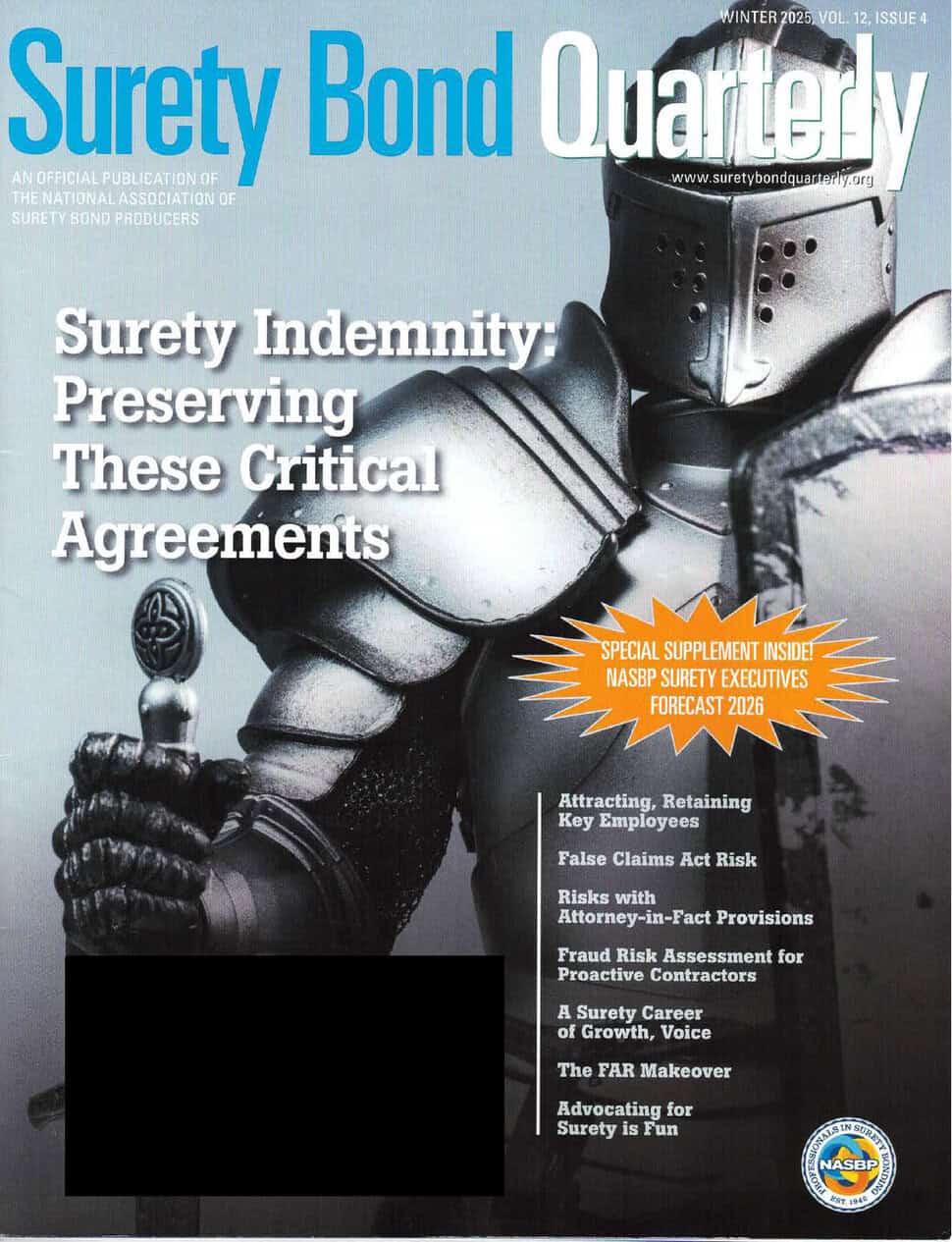
Adrian D’Arcy and Ashley Robinson Co-Authored “Electronic Signatures and Indemnity Agreements – Risks with Attorney-in-Fact Provisions” for the Winter 2025 Edition of Surety Bond Quarterly

Surety Bond Quarterly is the official, professional magazine of the National Association of Surety Bond Producers, providing industry insights, news, and developments for surety professionals, contractors, project owners, and government officials on surety bonds, construction, and related topics.
Adrian and Ashley discuss how electronic signatures have become prevalent across the United States, discuss the legal structure which facilitates electronic signatures, and detail possible risks associated with indemnity agreements being executed electronically with a focus on issues related to attorney-in-fact provisions.
Click on the thumbnails below to read the article.
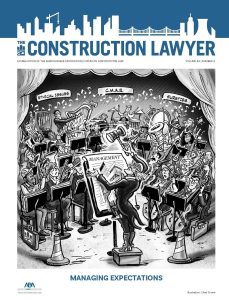
Ashley Robinson Co-Authored: Understanding Sureties: Why Do They Do What They Do?, for the ABA’s Construction Lawyer Fall 2025 Magazine, “Managing Expectations”

Ashley, along with Douglass Wynne Jr., detail how to learn about the risks sureties face when financing principals, their rights to contract funds, and how they can assert defenses related to the obligee’s actions and project specifications.
Click on the image below to log into the American Bar Association’s website to access the article.
Contracting Chaos? How Mid-America v. US Department of Transportation is Upending DBE Certifications, by Andrew Vicknair
D’Arcy Vicknair founding partner, Andrew Vicknair, recently authored a blog for the American Bar Association and posted on The Dispute Resolver: Contracting Chaos? How Mid-America v. US Department of Transportation is Upending DBE Certifications.
What Everyone Needs to Know About Schedule Float, by Andrew Vicknair
D’Arcy Vicknair founding partner, Andrew Vicknair, recently authored a blog for the American Bar Association and posted on The Dispute Resolver: What Everyone Needs to Know About Schedule Float.
D’Arcy Vicknair Partners Cycle for Charity in Ireland

Learn More
Sureties and Pay-If-Paid Clauses: Balancing Subcontractor Protection with Freedom to Contract, by Adrian D’Arcy and Ashley Robinson

Subcontractor Default Insurance: What Is It? by Andrew Vicknair

Delay Claims – Part II; Methods of Proving Delays and Required Documentation by Andrew Vicknair and Heather Shore
Delay Claims – Part II; Me
By D’Arcy Vicknair founding partner, Andrew Vicknair, and Heather Shore of Baker Sterchi Cowden & Rice.
What Every Project Participant Needs to Know About Delay Claims, by Andrew Vicknair
D’Arcy Vicknair founding partner, Andrew Vicknair, recently authored a blog for the American Bar Association and posted on The Dispute Resolver: What Every Project Participant Needs to Know About Delay Claims.
Louisiana Supreme Court: Claims for Indemnity are not Premature, by Margaret Davis

On Friday, the Louisiana Supreme Court issued a written opinion in Daniel Bennett v. Demco Entergy Services, LLC et. al., No. 2023-CC-01358 (5/10/24) finally settling an important conflict in Louisiana law. The Court found that cross claims for contractual indemnity and defense are not premature when they are asserted before liability is determined in the main demand. For several years, a circuit split emerged based on several Louisiana Supreme Court decisions that led courts in some circuits to find that cross claims for indemnity were premature before liability was determined. In the construction context, this frequently led to harsh consequences for general contractors, because while they waited for liability to be determined in the main demand, their indemnity cross claims against subcontractors were perempted (dead or unactionable) after five years under La. R.S. 9:2272. In short, cross claims could be premature during the five-year limit and perempted after the five-year limit.